
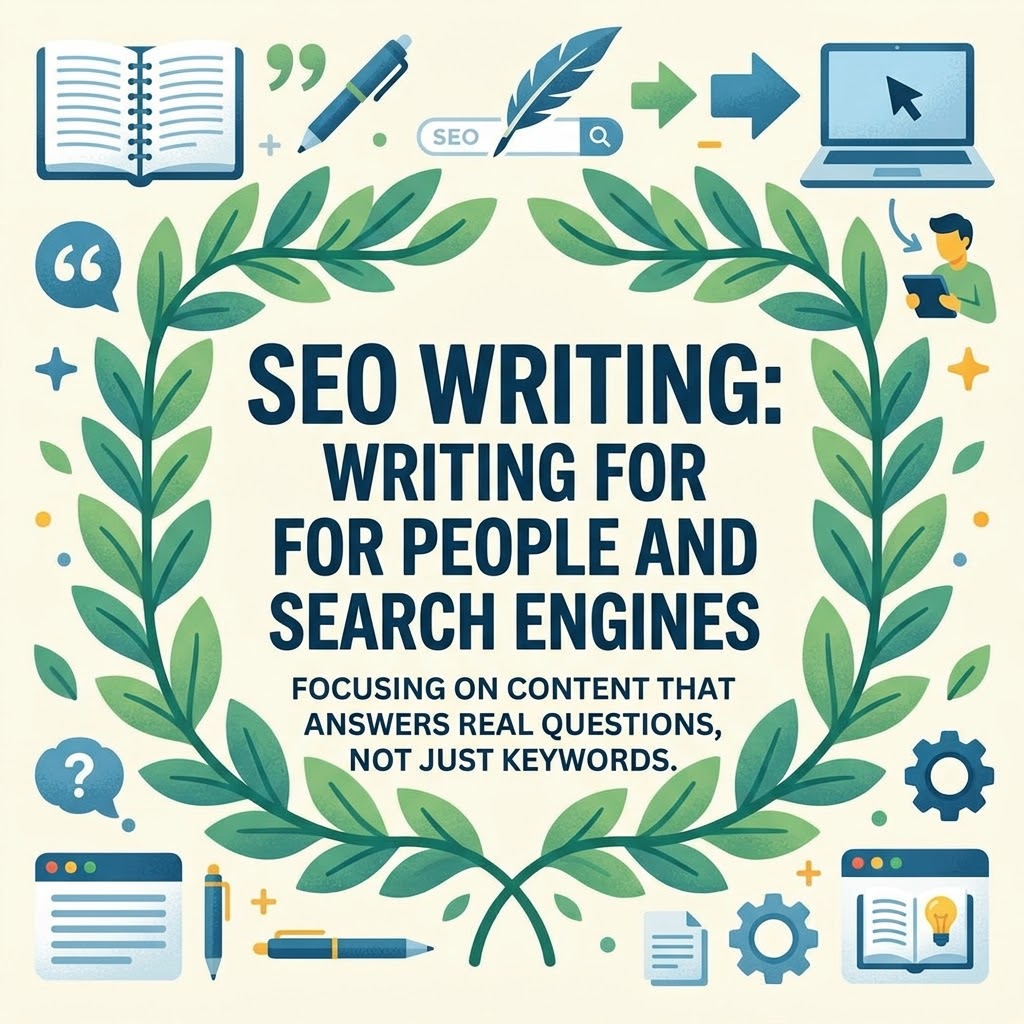
SEO Writing: Writing for People and Search Engines
You’ve probably heard that you should use keywords when writing for SEO.
That’s true, but SEO writing is about much more than sprinkling keywords throughout an article and hoping Google notices.
Good SEO writing starts with something much simpler:
Write something worth finding.
What is SEO writing?
SEO writing is the practice of creating useful, relevant content while also making it easier for search engines to understand what that content is about.
That can include blog posts, website pages, product descriptions, service pages, and other forms of online writing.
The goal isn’t to write an article that sounds like it was created for a search engine.
The goal is to write something a real person would actually want to read.
Start with your reader
Before worrying about keywords, think about the person you’re writing for.
What are they trying to learn?
What problem are they trying to solve?
What question brought them to your page?
Understanding the reader gives you a much better starting point than simply choosing a keyword and writing around it.
For example, someone searching for “how to start a WordPress blog” probably isn’t looking for a page that repeats those words fifty times.
They’re looking for an answer.
Your job as a writer is to give them one.
Keywords still matter, but don’t force them!
Keywords help you understand what people are searching for and give you clues about the topic your content should address.
You can use a primary search phrase and related terms throughout your writing, but they should fit naturally.
If a sentence sounds strange because you’re trying to squeeze a keyword into it, rewrite the sentence.
Natural writing is usually better than awkward keyword placement.
Search engines can understand variations and related language, so you don’t have to write like a robot trying to hit a keyword quota. Google even notes that you don’t need to anticipate every possible variation of a user’s search wording.
Make your writing easy to read
Online readers tend to scan.
That means giant walls of text aren’t doing you any favors.
Use:
– Clear headings
– Shorter paragraphs
– Descriptive subheadings
– Lists when they make sense
– Straightforward language
– Relevant links
Good formatting helps your reader find the information they’re looking for.
It can also help search engines understand the organization and subject of your page. Google recommends well-organized, easy-to-read content with headings that help users navigate an article.
Don’t write just to reach a word count
There isn’t a magic number of words that automatically makes an article good at SEO.
A 500-word article can be more useful than a 2,000-word article if it answers the reader’s question clearly.
Likewise, a complicated topic might genuinely require a longer article.
Write enough to properly cover the subject, not enough to hit some imaginary SEO word-count requirement.
Give the reader something useful
This is where SEO writing becomes more than keyword placement.
Your content should actually accomplish something.
Maybe it answers a question, teaches a skill, helps someone choose between two options, or explains something confusing in simpler language.
Whatever the purpose, make sure the reader gets something out of it.
Google’s current guidance emphasizes helpful, reliable, people-first content rather than content created primarily to attract search traffic.
SEO writing isn’t about sounding like SEO
That’s probably the biggest thing to remember.
If your writing is stuffed with repetitive phrases, awkward sentences, and unnecessary paragraphs just to make an article longer, you’re not improving the experience for your reader.
You’re making it worse.
Good SEO writing should still sound like good writing.
Research what your audience is searching for. Understand the topic. Organize your thoughts. Use relevant language naturally. Then write something that genuinely helps.
SEO can help people find your writing. Good writing gives them a reason to stay.
Leave a Reply